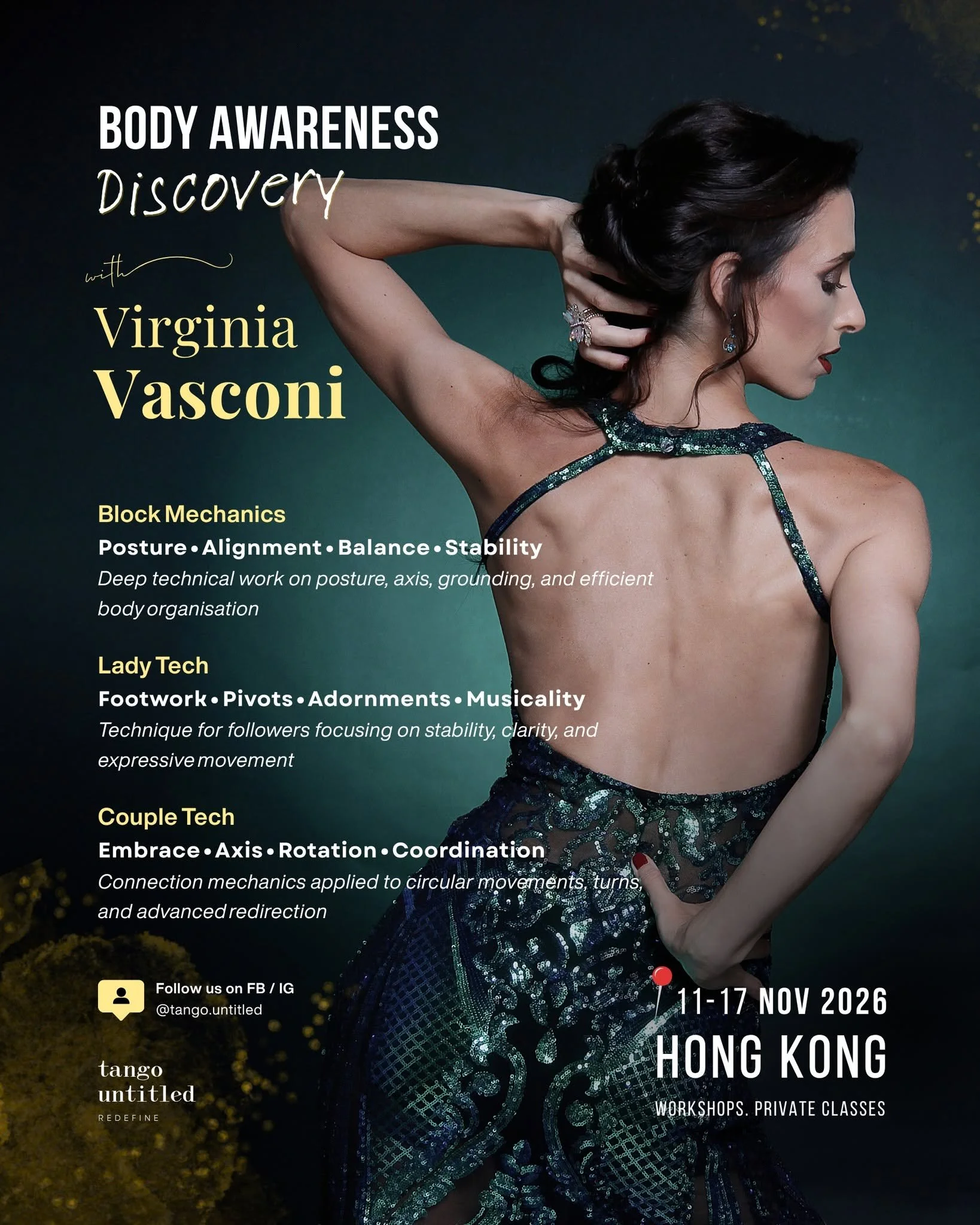
BODY AWARENESS DISCOVERY
with Virginia Vasconi
11–17 NOV 2026 · Hong Kong
A Different Kind of Attention
As our tango develops, our attention often shifts.
Less:
What should I learn next?
More:
Why does balance change once I start moving?
Why does a simple movement require more effort on some days than others?
Why do pivots feel reliable one moment and disappear the next?
Why does the same turn feel different with different partners?
In Body Awareness Discovery, Virginia Vasconi invites us to explore some of the things beneath these experiences: balance, support, coordination, movement organisation and partner connection.
Not through imitation alone, but through understanding.
The Workshops
-
Most dancers can find balance while standing still.
The challenge begins when we walk, pivot, rotate, accelerate or change direction.
Many of us have experienced:
one side feels different from the other
balance changes when the music becomes faster
a simple movement requires more effort than expected
stability comes and goes throughout a dance
These workshops explore posture, balance, grounding and body awareness as dynamic processes that change while we move.
Not searching for a perfect posture, but understanding how our own body organises itself in motion.
Focus
• Posture and alignment
• Balance and axis
• Grounding and stability
• Body awareness in movement -
Many followers are not looking for more adornments.
They are looking for movement that feels:
stable
comfortable
responsive
musical
Yet we often experience pivots becoming less reliable, expression disappearing under pressure, or musicality becoming harder to access when movement becomes challenging.
These workshops explore the relationship between support, stability and expression.
Building a stronger foundation so that movement can remain available to both partner and music.
Focus
• Foot and leg technique
• Pivots and turns
• Adornments
• Musicality and expression -
It is how two people organise movement together.
Many dancers have experienced turns that feel clear and effortless one moment, then unexpectedly heavy or complicated the next.
What changes?
These workshops explore how intention is transmitted through the embrace, and how coordination, timing, axis management and rotation influence the quality of movement for both partners.
The material draws on principles developed and taught by Virginia Vasconi and Julio Balmaceda over years of international teaching and performance work.
The goal is not larger figures.
The goal is greater clarity, continuity and less effort.
Focus
• Functional embrace
• Rotation and changes of direction
• Axis management
• Timing and intention
• Upper and lower body coordination -
You may recognise some of these thoughts:
I know the movement, but I cannot always find a comfortable way to do it.
My balance changes depending on the movement, music or partner.
One side feels different from the other.
My pivots are not always consistent.
I sometimes work harder than I need to.
I want movement that feels more natural and efficient.
I want to better understand how connection is created and maintained.
I am interested not only in what works, but why it works.
If these experiences feel familiar, perhaps this series is for you.
About Virginia
Virginia Vasconi is an Argentine tango dancer, teacher, choreographer and movement researcher and official judge for prestigious Tango championships worldwide. She has dedicated more than twenty years exclusively to Argentine Tango.
Her wider movement background includes ballet, artistic gymnastics, jazz dance, contemporary dance, yoga, stretching and body conditioning. Bringing these disciplines together, Virginia has developed an integrative approach centred on natural, functional and healthy movement.
After moving to Buenos Aires in 2008, Virginia spent seven years teaching and performing with the renowned DNI Tango School and Company, directed by Dana Frígoli.
DNI became known for a systematic and analytical approach to understanding tango movement. Rather than relying only on imitation or intuition, its methodology investigates how the body functions, coordinates and communicates through movement. This period contributed to Virginia’s continuing interest in biomechanics, body awareness and how movement can be understood rather than simply reproduced.
From 2015 to 2019, Virginia partnered with Julio Balmaceda, one of tango’s most respected teachers and educators. Together they travelled internationally, teaching and performing while developing and refining material around turns, circular movement, changes of direction and partner coordination.
The two Couple Tech sessions in this programme draw on material developed and taught during their partnership.
Virginia is also the creator of Art in Motion and Block Biomechanics by Virginia Vasconi, a registered training method developed to improve stability, balance, movement efficiency and body awareness.
Her teaching asks not only:
What should the movement look like?
It also asks:
How does the movement work in my body?